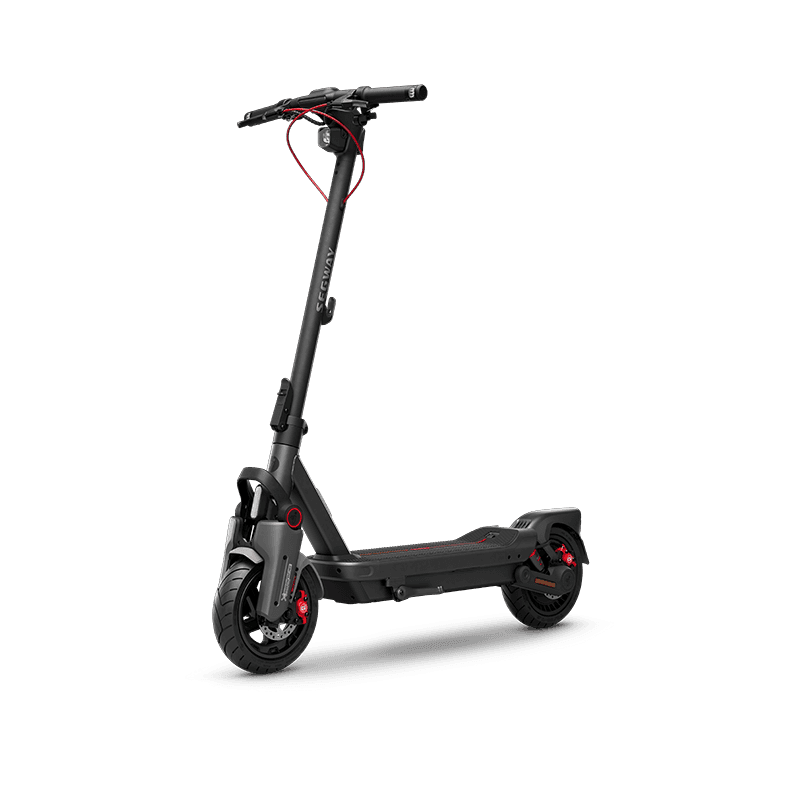

The measured numbers, side by side
| Segway MAX G3 | Segway MAX G2 | |
|---|---|---|
| Claimed range | 50 mi (at 10 mph) | 43 mi (theoretical) |
| Segway's own at-speed figure | 25 mi in Sport+ | 25 mi at 22 mph / 28 mi at 20 mph |
| Measured range | 24.9 mi (ERideHero) | 29.8 mi (ERideHero) · 26.6 mi (RiderGuide) |
| Claimed top speed | 28 mph | 20 mph default, 22 mph unlocked |
| Measured top speed | 28 mph | 22.4 mph (ERideHero) · 21.7 mph (RiderGuide) |
| Battery | 597 Wh | 551 Wh |
| Suspension | Front and rear adjustable hydraulic | Front hydraulic |
| Water resistance | IPX6 | IPX5 |
| Max payload | 286 lb | 265 lb |
Compared on the same outlet's protocol — ERideHero measured both — the older G2 travelled 4.9 miles further than the newer G3 while claiming seven miles less. That is not a mistake in either measurement. It is the difference between a scooter that tops out at 22 mph and one that tops out at 28: the faster scooter spends its extra 46Wh on speed, and then some.
Both scooters tell the truth further down the page
Segway publishes a second range figure for both models, for riding at or near top speed. The G3 is quoted at 25 miles in Sport+ and measured 24.9. The G2 is quoted at 25 miles at 22 mph and measured 26.6 and 29.8. Segway's at-speed figures are accurate to within a mile on one model and conservative on the other, while the headline figures are out by 40 to 50%. The full pattern is in claimed vs measured range.
What the G3 actually improves
- Speed: 28 mph against 22. The single largest real difference, and the reason the G3's measured range is lower.
- Rear suspension. The G3 has adjustable hydraulic front and rear; the G2 is front only. On broken city pavement this is the upgrade riders notice most.
- IPX6 against IPX5, and 11-inch tyres against 10-inch.
- 286 lb payload against 265 lb, which matters more than it sounds if you carry cargo.
- Front and rear disc brakes in place of a front drum. At 28 mph this is a requirement, not a luxury.
Which to buy
- Buy the MAX G2 if 22 mph is enough. It has the best measured range of any Segway in the index, it is cheaper, and the front-only suspension is the only real compromise.
- Buy the MAX G3 for 28 mph, rear suspension, disc brakes and better sealing — accepting that measured range goes down, not up.
- Check the state limit first. 28 mph is above the line several US states draw. The G2 at its 20 mph factory default sits inside it. See street-legal 20 mph scooters.
Frequently asked questions
Does the Segway MAX G3 have better range than the MAX G2?
Measured, no. ERideHero recorded 24.9 miles for the MAX G3 and 29.8 for the MAX G2; RiderGuide recorded 26.6 for the G2. The G3 claims 50 miles and the G2 claims 43, so the claimed figures point the opposite way to the measured ones. The G3's higher 28 mph top speed is where the energy goes.
Is the MAX G3 worth upgrading to from a MAX G2?
Only for speed, rear suspension, disc brakes and IPX6 sealing. If the G2's 22 mph is adequate and the ride quality is acceptable, the upgrade buys no additional distance and by two independent measurements costs some.
How fast is the Segway MAX G2 really?
20 mph in the factory default condition and 22 mph once unlocked in the Segway-Ninebot app. Independent measurements came in at 22.4 mph (ERideHero) and 21.7 mph (RiderGuide), so the unlocked claim is honest.
Every Segway tier ranked on measured range: the Segway Ninebot lineup compared.
Where the measured figures come from
Electric Scooter Guides does not run instrumented range or speed tests. Every measured figure quoted above belongs to the independent outlet named beside it: ERideHero, RiderGuide and Electric Scooter Guide (a separate publication). The full row-by-row record, with a live link on every figure, is in the measured specification index.
Manufacturer figures are labelled as claims throughout, because across 37 measured runs covering 34 models scooters delivered an average of 64% of claimed range. The mechanism is set out in why range claims are wrong.